Combination oily to acne-prone skin
Body acne: definition, causes and treatments
Reading time : 9 min
Body acne: definition, causes and treatments
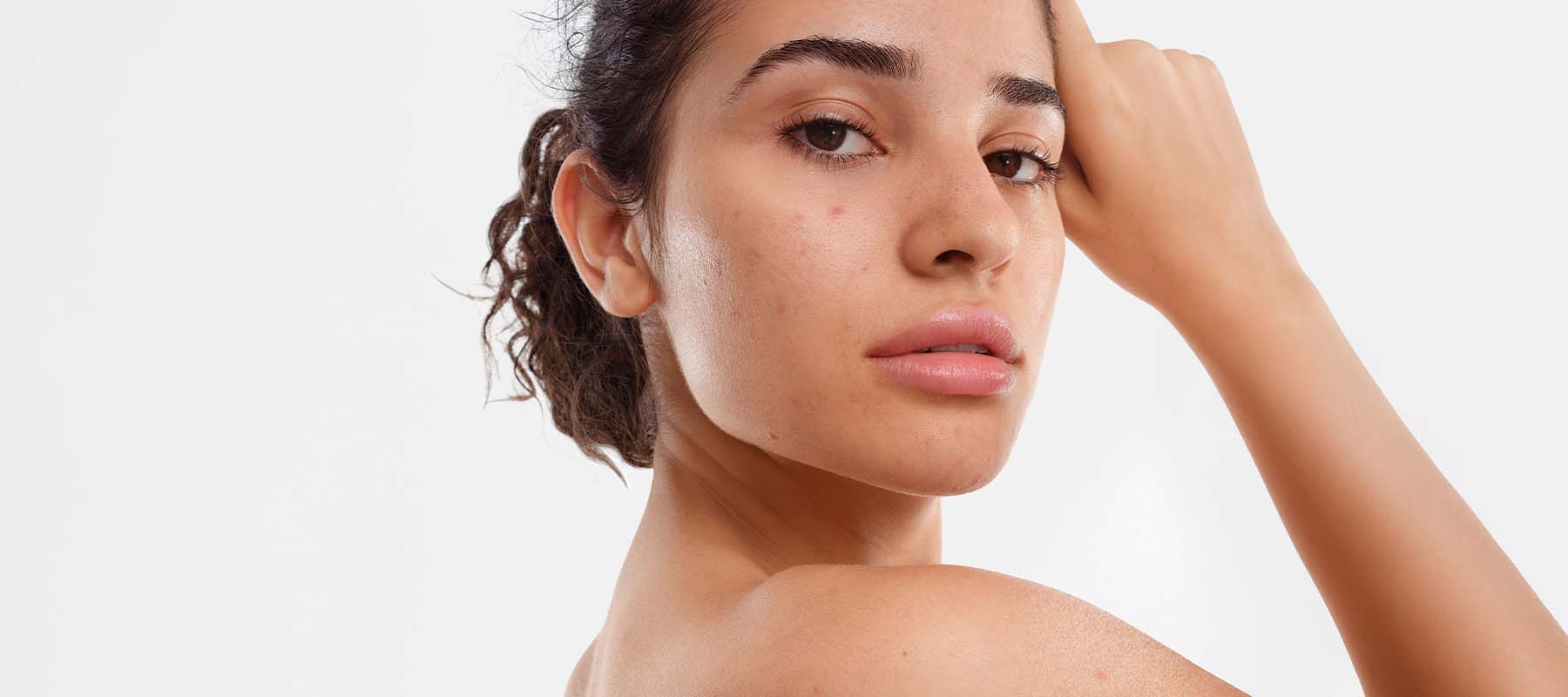
Body acne is an underdiagnosed pathology¹ that has been much less extensively studied than face acne² . According to existing studies, 50% of adolescents affected by face acne also suffer from body acne³. Body acne can affect people of all ages. Men seem to be more affected than women.⁴
Which parts of the body are affected by body acne?
Body acne can affect different areas. It is mainly found on the upper back (52%), décolleté (30%), lower back (22%), shoulders and upper arms (16%) and neck (8%)⁵ . The specific characteristics of the skin in these areas makes body acne different from face acne, and often more difficult to manage:
- Gentle on skin’s natural pH
- Thicker
- More sweat glands in some areas that produce more sebum
- Sweats more
- Rubs with clothes that can aggravate acne
What are the symptoms of body acne?
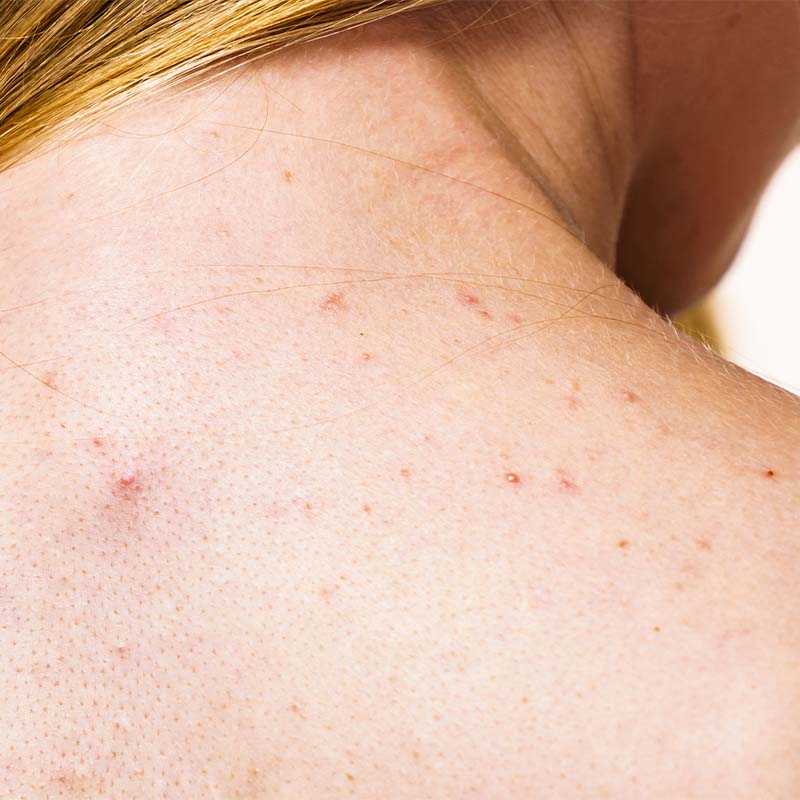
The signs of body acne are very similar to face acne, including whiteheads, blackheads, papules, pustules and microcysts. There may be slightly puffy inflammatory lesions that are red and painful, as well as blocked pores with no inflammation. As for the face, the impact of body acne on quality life is significant and can lead to low self-esteem, particularly when both the face and body are affected. 50% of people affected says that they feel embarrassed and lack confidence in social relations⁶ . Body acne can lead to both physical and psychological suffering resulting in feelings of stigmatization, avoiding social interactions and sometimes depression⁷ .
What causes acne on the back and chest?
Body acne has the same root causes as face acne⁸ :
- Excessive sebum production, sometimes resulting from hormonal changes (e.g. adolescence, pregnancy or stress) or genetic predisposition
- Overproduction of skin cells (Hyperkeratinization) resulting in thicker skin from accumulated dead skin cells that block pores and prevent sebum flow
- An increase in bacteria (Cutibacterium acnes) that cause breakouts.
- Inflammation
Other factors that can aggravate body acne are genetics, ill-adapted cosmetic products, some medication, a high sugar diet, exposure to UV rays, excessive sweating, insufficient or inappropriate hygiene.
What are the types of body acne?
Acne mechanica
One form of body acne is acne mechanica, which gets its name from the cause of the lesions: mechanical rubbing of clothes or sports equipment against the skin. Repeated friction and sweating in non-wicking materials can provoke redness and pimples that are often inflammatory. These body acne lesions occur in areas exposed to prolonged contact:
- Forehead, head, chin and neck when wearing a helmet e.g. football, cycling, skateboard or hockey
- Shoulders and back from the straps of a rucksack, for example when hiking or trekking
- Back, shoulders and décolleté when synthetic sports clothes are worn too frequently or for long periods e.g. danse and gymnastics
Acne cosmetica
Acne cosmetica affects the face and body. It results from the use of certain cosmetics products that clog the pores. For body acne, this is the case with some hair products including shampoo, conditioner and other styling products, particularly if they contain oils and silicones. But it may also occur if certain shower gels are not completely rinsed off or with overly occlusive moisturizing balms and body makeup. A series of small pimples appears in the affected area.
Excessive sweating (hyperhidrosis)
Sweating is a natural phenomenon. However, excessive transpiration can lead to a buildup of impurities on the skin including sweat, makeup residues, pollution particles and dead skin cells. Bacteria multilply and pores become blocked, in some cases leading to the appearance body acne. While exercise itself does not cause acne, the buildup of sweat on the skin during a workout can allow bacteria to grow, which could inflame pores and cause acne.
How do you manage & prevent back or check acne?
Avoid triggers
The best strategy to prevent or manage body acne is to avoid triggers as much as possible.
- Manage stress e.g. meditation, breathing exercises and sport
- Avoid comedogenic cosmetic products
- Avoid exposure to UV without appropriate sun protection
- Limit sugar in your diet
- Choose breathable sportswear and wash it regularly
- Wash or clean hats, caps and bandanas
- Use appropriate protection when carrying sports equipment in contact with your skin
Use products developed for body acne
Best ingredients for body acne
You can also prevent or manage lesions by adopting a care routine that targets body acne⁹. This will also help avoid the risk of scarring, improving confidence and quality of life. When choosing skincare products, look out for active ingredients such as:
Salicylic acid acts on the different symptoms linked to face and body acne¹⁰. With a keratolytic action, it helps eliminate dead skin cells and stimulate cellular renewal. As an exfoliant, it unclogs pores. While sebum-regulating properties help rebalance sebum production. It has antibacterial properties that reduce the propagation of Cutibacterium acnes. It is also anti-inflammatory and antioxidant.
Niacinamide is a vitamin B3 derivative that is very well tolerated by the skin. It has a soothing, antioxidant and anti-inflammatory effect. It also helps regulate sebum production and prevent bacterial proliferation on the surface of the skin, helping prevent imperfections from forming. The results¹¹ depends on the concentration used.
Zinc gluconate is widely used in dermatology for its anti-inflammatory, anti-bacterial and sebum-regulating properties¹². It also accelerates skin repair. It is therefore a key active ingredient in skincare for oily and acne-prone skin. Zinc gluconate is well tolerated by all skin types, even sensitive skin.
When should you see a dermatologist?
We recommend adapting your lifestyle to avoid body acne triggers and adopting a targeted skincare routine first. If you do not see any improvement after several weeks, you could then contact your local doctor or a dermatologist.
¹Cavallo I, Sivori F, Truglio M, De Maio F, Lucantoni F, Cardinali G, et al. Skin dysbiosis and Cutibacterium acnes biofilm in inflammatory acne lesions of adolescents. Sci Rep. 6 dec 2022;12:21104
²Issa NT, Draelos Z, Tanghetti E, Kircik LH. Update on Truncal Acne: A Review of Treatments for a Neglected Disease and the Re-Emergence of Tazarotene. Journal of Drugs in Dermatology. 2022;21(12) Available from: https://jddonline.com/articles/supplement-individual-articles-update-on-truncal-acne-a-review-of-treatments-for-a-neglected-disease-and-the-re-emergence-of-tazarotene-S1545961622SSF3446185X/?_page=2, Accessed October 11, 2023
³Del Rosso JQ, Bikowski JB, Baum E, et al. A closer look at truncal acne vulgaris: prevalence, severity, and clinical significance. J Drugs Dermatol. 2007;6(6):597-600.
⁴Poli F, Auffret N, Leccia MT, Claudel JP, Dreno B. Truncal acne, what do we know? J Eur Acad Dermatol Veneorol. oct 2020;34(10):2241-6
⁵Ottaviani M, Alestas T, Flori E, Mastrofrancesco A, Zouboulis CC, Picardo M, Peroxydated squalene induces the production of inflammatory mediators in HaCaT keratincocytes: a possible role in acne vulgaris. J Invest Dermatol. nov 2006;126(11):2430-7
⁶Tan J, Beissert S, Cook-Bolden F, et al. Evaluation of psychological wellbeing and social impact of combined facial and truncal acne: a multi-national, mixed-methods study. Dermatol Ther (Heidelb). 2022;12(8):1847-1858. doi: 10.1007/s13555-022-00768-0
⁷Tan J, Chavda R, Leclerc M, Dréno B. Projective personification approach to the experience of people with acne and acne scarring— expressing the unspoken. JAMA Dermatol. 2022;158(9):1005. doi:10.1001/jamadermatol.2022.2742
⁸Tan J, Alexis A, Baldwin H, et al. The personalised acne care pathway—recommendations to guide longitudinal management from the personalising acne: consensus of experts. JAAD International. 2021;5:101-111. doi: 10.1016/j.jdin.2021.09.006
⁹Ballanger F, Claudel JP, Leccia MT, Auffret N, Stromstedt Camerati A, Dufaux PO, Marquié A, Dréno B. Truncal Acne in Adolescents and Young Adults: Self-reported Perception. Acta Derm Venereol. 2023;103:adv5123. doi: 10.2340/actadv.v103.5123.
¹⁰E. Zander and S. Weisman, Treatment of acne vulgaris with salicylic acid pads, Clin. Ther., vol. 14, no. 2, pp. 247 253, 1992, Accessed: Mar. 03, 2022. [Online]. Available: https://pubmed.ncbi.nlm.nih.gov/1535287/.
¹¹Bains P, Kaur M, Kaur J, Sharma S. Nicotinamide: Mechanism of action and indications in dermatology. Indian J Dermatol Venereol Leprol 2018;84:234-237
¹²Dreno, B., et al. "Low doses of zinc gluconate for inflammatory acne." Acta Derm Venereol 69.6 (1989): 541-3
¹³Clinical study on 34 subjects evaluating the efficacy and tolerance of Sébium Kerato+ Body by clinical scoring for 28 days
¹⁴Clinical study on 34 subjects evaluating the efficacy and tolerance of Sébium Kerato+ Body by self-assesment for 28 days
¹⁵Clinical study on 21 subjects evaluating the efficacy of Sébium Kerato+ Body by self-assesment for 21 days